
Sunday, September 10, 2017

Sunday, September 3, 2017
Sunday, August 20, 2017
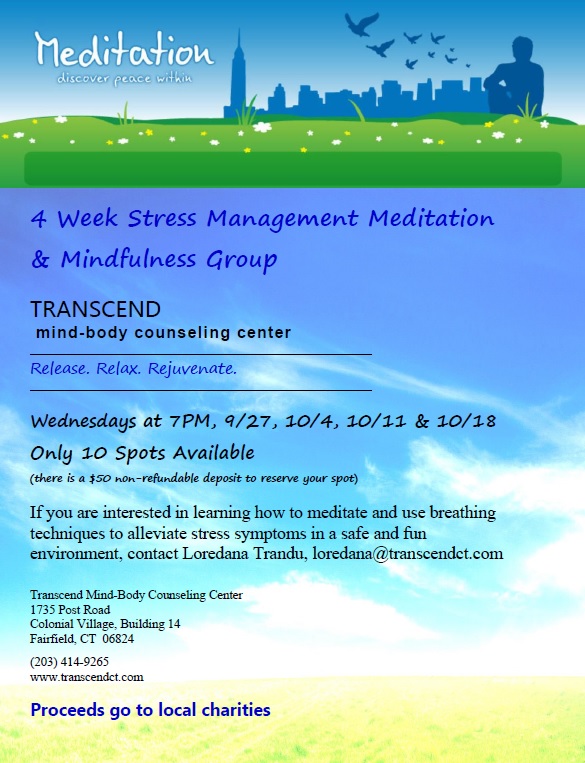
New Stress Management Group at Transcend!

New Stress Management Meditation and Mindfulness Group will begin in September at Transcend!
Wednesday evenings at 7 pm, 9/27, 10/4, 10/11 & 10/18
Only 10 spots available!
there is a $50 non-refundable deposit to reserve your spot)
Proceeds will go to local charities.
If you are interested in learning how to meditate and use breathing techniques to alleviate stress symptoms in a safe and fun environment, please contact Loredana Trandu:
loredana@transcend-mindbodytraining.com
Saturday, August 12, 2017
Ride the Waves of Discomfort When Dealing with Stress
article c/o yogajournal.com
go with the flow when dealing with stress, it may become easier.

Explore Uncomfortable Feelings
There it was, that nagging bright yellow Post-it note: "Call Sam." Sam was my former landlord, and he owed me a rental deposit, a decent amount of money I could put toward a mortgage payment. It had been months since I moved out, but I hadn't called, partly because Sam got angry so easily and partly because he had always made me feel like a six-year-old contending with the schoolyard bully. Just thinking about calling him filled me with anxiety.
Fortunately, after years of "riding the wave," a technique central to the practice of Kripalu Yoga, I had learned how to sit with and explore uncomfortable feelings. As I thought about the phone call, I deepened my breath and felt the tightness in my belly ease, only to be replaced by a sense of nausea, which turned into a feeling of helplessness, then dread. As these feelings intensified, I consciously relaxed my body and decided to welcome whatever showed up. Suddenly a thought popped into my head. "You have a rental contract. You'll be fine. Call him." This was no earth-shattering insight, but I immediately felt relieved and comfortable enough to call and negotiate with a clear mind and a relaxed body.
For more than a year I had dreaded making a 10-minute call. But by riding the waves of discomfort I was able to access a sense of inner balance and take on a challenge with more courage and confidence. I'd often practiced this technique while doing asanas to fully embrace the present; using it in my daily life helped me cultivate a sense of equanimity and poise.
When the going gets tough, the tough may get going, but most of us sidestep unease by distracting ourselves with anger, numbness, work, or substances that temporarily relieve the pain. That's because we're well versed in resisting the present moment, especially when it's thick with difficult or unpleasant things.
Often you may feel this resistance as a wave of sensation and emotion. Some waves are small and mildly irritating. Others can feel like tidal waves, overwhelming you in a roiling pool of dread, fear, and anxiety.
When you start to feel this resistance, try to stay with it and witness the inner turmoil rather than get sucked into it. If you can successfully ride the waves of sensation and emotion, you'll arrive at a state of compassion and wisdom.
So how can you move from fear and anxiety to insight and freedom? The secret is paying attention to sensations and the feelings that accompany them. Each time you focus on your breath, each time you relax and listen to your feelings, you open yourself to the present.
When you simply witness your feelings instead of reacting to them, you allow your life to unfold organically and you open a doorway to greater sympathy and understanding. Most important, you develop your capacity to be free in an often challenging and turbulent world.

Explore Uncomfortable Feelings
There it was, that nagging bright yellow Post-it note: "Call Sam." Sam was my former landlord, and he owed me a rental deposit, a decent amount of money I could put toward a mortgage payment. It had been months since I moved out, but I hadn't called, partly because Sam got angry so easily and partly because he had always made me feel like a six-year-old contending with the schoolyard bully. Just thinking about calling him filled me with anxiety.
Fortunately, after years of "riding the wave," a technique central to the practice of Kripalu Yoga, I had learned how to sit with and explore uncomfortable feelings. As I thought about the phone call, I deepened my breath and felt the tightness in my belly ease, only to be replaced by a sense of nausea, which turned into a feeling of helplessness, then dread. As these feelings intensified, I consciously relaxed my body and decided to welcome whatever showed up. Suddenly a thought popped into my head. "You have a rental contract. You'll be fine. Call him." This was no earth-shattering insight, but I immediately felt relieved and comfortable enough to call and negotiate with a clear mind and a relaxed body.
For more than a year I had dreaded making a 10-minute call. But by riding the waves of discomfort I was able to access a sense of inner balance and take on a challenge with more courage and confidence. I'd often practiced this technique while doing asanas to fully embrace the present; using it in my daily life helped me cultivate a sense of equanimity and poise.
Explore the Waves of Resistance and Discomfort
When the going gets tough, the tough may get going, but most of us sidestep unease by distracting ourselves with anger, numbness, work, or substances that temporarily relieve the pain. That's because we're well versed in resisting the present moment, especially when it's thick with difficult or unpleasant things.
Often you may feel this resistance as a wave of sensation and emotion. Some waves are small and mildly irritating. Others can feel like tidal waves, overwhelming you in a roiling pool of dread, fear, and anxiety.
When you start to feel this resistance, try to stay with it and witness the inner turmoil rather than get sucked into it. If you can successfully ride the waves of sensation and emotion, you'll arrive at a state of compassion and wisdom.
So how can you move from fear and anxiety to insight and freedom? The secret is paying attention to sensations and the feelings that accompany them. Each time you focus on your breath, each time you relax and listen to your feelings, you open yourself to the present.
When you simply witness your feelings instead of reacting to them, you allow your life to unfold organically and you open a doorway to greater sympathy and understanding. Most important, you develop your capacity to be free in an often challenging and turbulent world.
Find more articles at www.transcendct.com
Sunday, August 6, 2017
The Chemistry of Addiction and The Gateway to Freedom
This article is excerpted and adapted from the recently published best-selling book “The Integrity Effect” by Melissa Joy Jonsson.
The Chemistry of Addiction and The Gateway to Freedom
Addictions as Distractions
“Whoa, you like to think that you’re immune to the stuff, oh yeah / It’s closer to the truth to say you can’t get enough / You know you’re gonna have to face it, you’re addicted to love.” — Robert Palmer
Love. We are all addicted to love indeed. Not just the idea, not just the feeling, but the neurochemistry of love. The experience of love favorably changes our neurophysiology in both mind and body. When we experience love, our body produces its own natural opiates, endorphins, the feel-good neurotransmitters. Among these chemicals is oxytocin, often called our “love hormone” because of its crucial role in mother–child relationships, social bonding, and intimacy (oxytocin levels soar during sex).
Interestingly, oxytocin has also been shown to mitigate fear. When oxytocin is administered to people with certain anxiety disorders, activity declines in the amygdala—the primary fear center in the brain. As a result, people feel less fearful. Thus exogenous oxytocin, along with other fear-reducing compounds in clinical development, may eventually be used to treat post-traumatic stress disorder (PTSD) and other fear-related conditions.
Addicted to Love
We are hard-wired for love. Our bodies crave love as much as oxygen and water. Many people do not realize that the neurochemistry produced through love is the same neurochemistry produced by the brain while engaging in addictive behaviors. Thus addiction may breed easily in a person starving for love. Love and addiction have the same initial chemical impact on the body–mind connection.
According to studies of the brain using functional magnetic resonance imaging (fMRI), the sensation of love is processed in three areas of the brain.
Area 1: Ventral Tegmental Area (Dopamine). The first area is the ventral tegmental area (VTA), a clump of tissue in the brain’s lower regions that is the body’s central refinery for dopamine. Dopamine performs many functions but primarily regulates reward. Winning the lottery can produce a thrilling rush of dopamine. Remarkably, the VTA also becomes active when one feels the rush of cocaine.
Area Two: Nucleus Accumbens (Oxytocin). Thrill signals that start in the lower brain are then processed in the nucleus accumbens via dopamine, serotonin, and oxytocin. New mothers are flooded with oxytocin during labor and nursing, supporting a strong connection to their babies.
According to neuroscientists,
"this association between rewarding experiences and dopamine levels in the nucleus accumbens initially caused many neuroscientists to believe the main role of the nucleus accumbens was in mediating reward. Thus, it is often implicated in addiction and the processes that lead to addiction.
However, since the initial links were made between the nucleus accumbens and reward, it has been discovered that dopamine levels in the nucleus accumbens rise in response to both rewarding and aversive stimuli [emphasis added]. This finding led to a re-evaluation of the functions of the nucleus accumbens, and indeed of the functions of dopamine as a neurotransmitter. The most widely accepted perspective now is that dopamine levels don’t rise only during rewarding experiences but instead rise anytime we experience something that can be deemed either positive or negative.
Area 3: The Caudate Nuclei (Dopamine). The last major area for love signals in the brain are the caudate nuclei, a pair of structures on either side of the head, each about the size of a shrimp. It’s here that patterns and mundane habits, such as knowing how to drive a car or cook spaghetti, are stored.
We are hard-wired for love. Our bodies crave love as much as oxygen and water. Many people do not realize that the neurochemistry produced through love is the same neurochemistry produced by the brain while engaging in addictive behaviors. Thus addiction may breed easily in a person starving for love. Love and addiction have the same initial chemical impact on the body–mind connection.
According to studies of the brain using functional magnetic resonance imaging (fMRI), the sensation of love is processed in three areas of the brain.
Area 1: Ventral Tegmental Area (Dopamine). The first area is the ventral tegmental area (VTA), a clump of tissue in the brain’s lower regions that is the body’s central refinery for dopamine. Dopamine performs many functions but primarily regulates reward. Winning the lottery can produce a thrilling rush of dopamine. Remarkably, the VTA also becomes active when one feels the rush of cocaine.
Area Two: Nucleus Accumbens (Oxytocin). Thrill signals that start in the lower brain are then processed in the nucleus accumbens via dopamine, serotonin, and oxytocin. New mothers are flooded with oxytocin during labor and nursing, supporting a strong connection to their babies.
According to neuroscientists,
"this association between rewarding experiences and dopamine levels in the nucleus accumbens initially caused many neuroscientists to believe the main role of the nucleus accumbens was in mediating reward. Thus, it is often implicated in addiction and the processes that lead to addiction.
However, since the initial links were made between the nucleus accumbens and reward, it has been discovered that dopamine levels in the nucleus accumbens rise in response to both rewarding and aversive stimuli [emphasis added]. This finding led to a re-evaluation of the functions of the nucleus accumbens, and indeed of the functions of dopamine as a neurotransmitter. The most widely accepted perspective now is that dopamine levels don’t rise only during rewarding experiences but instead rise anytime we experience something that can be deemed either positive or negative.
Area 3: The Caudate Nuclei (Dopamine). The last major area for love signals in the brain are the caudate nuclei, a pair of structures on either side of the head, each about the size of a shrimp. It’s here that patterns and mundane habits, such as knowing how to drive a car or cook spaghetti, are stored.
CAU: Cause to Pause
The caudate nucleus integrates complex emotions and thoughts about love. The caudate nuclei (CAU) are all about making choices, but they are also connected to addictions because of their role in feeling pleasure, relief, and comfort. In many cases, the reason why a person may choose addiction can be buried in the unconscious, but the caudate nuclei of the brain may hold keys to the pattern. Interestingly, studies have shown that people who have damage to the CAU show repetitive and compulsive behavior. They will keep doing a thing over and over again, even though it’s unnecessary and doesn’t do them any good.
According to neuroscientists,
"the Caudate is also part of the Reward System. It lies in the middle of your head and looks a bit like a medium-sized shrimp—two shrimp, actually, as each hemisphere of the brain has its own Caudate. The caudate and other regions of the striatum have connections to the cerebral cortex, the top, multi-folded layer of the brain with which we do our thinking. It has connections, too, with memory areas and with the ventral-tegmental area VTA. Indeed, the Caudate integrates data from many brain regions. No part of the brain ever works alone, and love is no exception [emphasis added].
Researchers speculate that as all of our thoughts, feelings, and motivations associated with love assemble in the caudate, we experience states of bliss.
We Are All Addicts
To some extent, we are all addicts! We are all addicted to love, and when love is seemingly not available, we will reach for anything as a cheap substitute to produce the feel-good chemistry.
An addiction is something that causes psychological dependence, so it is a mental and cognitive problem in addition to a physical ailment.5 According to the Diagnostic and Statistical Manual of Mental Disorders, an addiction is classified as a dependence. Dependence is “characterized by compulsive, sometimes uncontrollable, behaviors that occur at the expense of other activities and intensify with repeated access.”
I define addiction as follows: all addictions are placeholders in awareness that represent an attempt to find True Authentic Self and simultaneously avoid it. The placeholder that the addiction pattern represents serves as a habituated strategy to avoid recognizing self as an infinitely whole, perfect, and limitless being that is having an experience of limitation.
The pattern as placeholder serves as a habituated strategy to look for fulfillment and acceptance of True Authentic Self in something outside of self that is inherently and incessantly empty. In this recognition, there is freedom to recondition awareness and embrace integrity. There is freedom to move from dis-ease to flow in total acceptance— and to choose anew.
Addicts are not the addictions; rather, these people are individuals in resonance with habituated, constricted containers of consciousness that perpetuate a behavioral loop.
Break the connection with the habit, establish resonance with a different, more useful placeholder that is a reflection of love, and the addictive pattern will transform, dissipate, subside, and cease naturally.
The addiction is a bit like looking in the mirror while simultaneously trying to look away. When mired in the addiction, we cannot see ourselves clearly.
To me, addictions are more like a two-way mirror aligned between our True Authentic Self and the addictive pattern. A two-way mirror is a mirror that is partially reflective and partially transparent. When one side of the mirror is brightly lit and the other is dark, it allows viewing from the darkened side, but not vice versa.
The addict sees the reflection of self as the mirror image of the addictive behaviors and cannot see anything else. What is reflected is based on the filters of what is being projected—addiction as confusion.
Conversely, the True Authentic Self can shine light on the addictive pattern and see clearly through the two-way mirror. True Authentic Self can see through the addiction to the truth of the essential self as love.
Love is the only placeholder worth keeping, and self-love is the gateway to freedom from all addictions. Love as the placeholder returns the power of choice and provides liberation from the shackles and confines of addictive patterns that subtract from our well-being.
To engage by compulsion is to cage without compassion. To engage by choice means the experience of the sum total self as a whole being is occurring without the addiction as placeholder. Addiction is not an addition to self. Addiction subtracts us from recognizing our own inherent completion as one love.
According to the preceding definition, we all may be addicted to something. Whether it is drugs, alcohol, food, sex, sugar, shopping, exercise, work, social media, chocolate, drama, or our own story, we are all looking for love, connection, and feelings of completion We are addicted to distractions as placeholders.
Certainly some addictions are more detrimental to our lives than others. Some addictions are even deemed healthy, such as exercise and work. Nonetheless, consider that there is no difference between addictions, as all are attempts to connect to self-love from a space of completion. The consequences and Ricochet Effects may be more pronounced with some addictions than with others, but the core impetus driving the placeholder of addiction is always the same: seeking love.
To some extent, we are all addicts! We are all addicted to love, and when love is seemingly not available, we will reach for anything as a cheap substitute to produce the feel-good chemistry.
An addiction is something that causes psychological dependence, so it is a mental and cognitive problem in addition to a physical ailment.5 According to the Diagnostic and Statistical Manual of Mental Disorders, an addiction is classified as a dependence. Dependence is “characterized by compulsive, sometimes uncontrollable, behaviors that occur at the expense of other activities and intensify with repeated access.”
I define addiction as follows: all addictions are placeholders in awareness that represent an attempt to find True Authentic Self and simultaneously avoid it. The placeholder that the addiction pattern represents serves as a habituated strategy to avoid recognizing self as an infinitely whole, perfect, and limitless being that is having an experience of limitation.
The pattern as placeholder serves as a habituated strategy to look for fulfillment and acceptance of True Authentic Self in something outside of self that is inherently and incessantly empty. In this recognition, there is freedom to recondition awareness and embrace integrity. There is freedom to move from dis-ease to flow in total acceptance— and to choose anew.
Addicts are not the addictions; rather, these people are individuals in resonance with habituated, constricted containers of consciousness that perpetuate a behavioral loop.
Break the connection with the habit, establish resonance with a different, more useful placeholder that is a reflection of love, and the addictive pattern will transform, dissipate, subside, and cease naturally.
The addiction is a bit like looking in the mirror while simultaneously trying to look away. When mired in the addiction, we cannot see ourselves clearly.
To me, addictions are more like a two-way mirror aligned between our True Authentic Self and the addictive pattern. A two-way mirror is a mirror that is partially reflective and partially transparent. When one side of the mirror is brightly lit and the other is dark, it allows viewing from the darkened side, but not vice versa.
The addict sees the reflection of self as the mirror image of the addictive behaviors and cannot see anything else. What is reflected is based on the filters of what is being projected—addiction as confusion.
Conversely, the True Authentic Self can shine light on the addictive pattern and see clearly through the two-way mirror. True Authentic Self can see through the addiction to the truth of the essential self as love.
Love is the only placeholder worth keeping, and self-love is the gateway to freedom from all addictions. Love as the placeholder returns the power of choice and provides liberation from the shackles and confines of addictive patterns that subtract from our well-being.
To engage by compulsion is to cage without compassion. To engage by choice means the experience of the sum total self as a whole being is occurring without the addiction as placeholder. Addiction is not an addition to self. Addiction subtracts us from recognizing our own inherent completion as one love.
According to the preceding definition, we all may be addicted to something. Whether it is drugs, alcohol, food, sex, sugar, shopping, exercise, work, social media, chocolate, drama, or our own story, we are all looking for love, connection, and feelings of completion We are addicted to distractions as placeholders.
Certainly some addictions are more detrimental to our lives than others. Some addictions are even deemed healthy, such as exercise and work. Nonetheless, consider that there is no difference between addictions, as all are attempts to connect to self-love from a space of completion. The consequences and Ricochet Effects may be more pronounced with some addictions than with others, but the core impetus driving the placeholder of addiction is always the same: seeking love.
Sugar High
In many ways, we are conditioned for addictions from a young age.
Perhaps we would receive a Twinkie or Ding-Dong when we finished all our chores? Perhaps when mom was trying to get work done and we were hungry for attention, mom may have innocuously given us a sugar treat to buy herself some much-needed time. This reward system can prime our bodies for addiction as the mind gets double the love pleasure—a treat from mom and a treat for the body. However, treat or trick? Recent research has shown that sugar is eight times more addictive than cocaine.
Both cocaine and sugar elevate dopamine levels in the nucleus accumbens. Prolonged exposure to either causes down-regulation of the dopamine receptors, which means less dopamine becomes available. Over time, more sugar (or drugs) is required to attain normal dopamine levels. This means that, over time, we need processed sugar just to feel normal. We may even be allergic to sugar, which will make us crave it more. We crave what is not good for us too. Recall that dopamine levels in the nucleus accumbens rise in response to both rewarding and aversive stimuli.
As we grow older, we may switch our addiction from sugar to drugs and alcohol, which might be more “socially acceptable” under the guise of peer pressure. Or perhaps we may continue to eat sugar and then diet to lose the weight, which could lead those more vulnerable to develop eating disorders. Or maybe carbs are what we crave. Perhaps we give up the sugar but add caffeine, as it helps us study and work. Or maybe we don’t think about the soda pop we consume as we spend a few hours playing video games online with friends we have never met.
In many ways, we are conditioned for addictions from a young age.
Perhaps we would receive a Twinkie or Ding-Dong when we finished all our chores? Perhaps when mom was trying to get work done and we were hungry for attention, mom may have innocuously given us a sugar treat to buy herself some much-needed time. This reward system can prime our bodies for addiction as the mind gets double the love pleasure—a treat from mom and a treat for the body. However, treat or trick? Recent research has shown that sugar is eight times more addictive than cocaine.
Both cocaine and sugar elevate dopamine levels in the nucleus accumbens. Prolonged exposure to either causes down-regulation of the dopamine receptors, which means less dopamine becomes available. Over time, more sugar (or drugs) is required to attain normal dopamine levels. This means that, over time, we need processed sugar just to feel normal. We may even be allergic to sugar, which will make us crave it more. We crave what is not good for us too. Recall that dopamine levels in the nucleus accumbens rise in response to both rewarding and aversive stimuli.
As we grow older, we may switch our addiction from sugar to drugs and alcohol, which might be more “socially acceptable” under the guise of peer pressure. Or perhaps we may continue to eat sugar and then diet to lose the weight, which could lead those more vulnerable to develop eating disorders. Or maybe carbs are what we crave. Perhaps we give up the sugar but add caffeine, as it helps us study and work. Or maybe we don’t think about the soda pop we consume as we spend a few hours playing video games online with friends we have never met.
Social Media Mania
Maybe we think we are clean and free of substance addictions, but we compulsively spend hours a day on Facebook, trolling our newsfeed and other people’s sites. We crave the attention we get from our posts and calibrate our self-worth and popularity based on how many likes we receive. Dopamine levels surge every time someone comments on our posts. We may even argue with people who have varying views and find it thrilling when we can get a rise out of a stranger whom we have the power to block.
Perhaps we are plugged in to social media all the time. But not without paying a price. How many real-life friends do we still socialize with in person? Do we substitute real intimacy for the virtual reality of addictive online connections?
A recent University of Copenhagen study suggests excessive use of social media can create feelings of envy. It particularly warns about the negative impact of “lurking” on social media without connecting with anyone. The study of more than one thousand participants says that “regular use of social networking such as Facebook can negatively affect your emotional well-being and satisfaction with life.”
Maybe we think we are clean and free of substance addictions, but we compulsively spend hours a day on Facebook, trolling our newsfeed and other people’s sites. We crave the attention we get from our posts and calibrate our self-worth and popularity based on how many likes we receive. Dopamine levels surge every time someone comments on our posts. We may even argue with people who have varying views and find it thrilling when we can get a rise out of a stranger whom we have the power to block.
Perhaps we are plugged in to social media all the time. But not without paying a price. How many real-life friends do we still socialize with in person? Do we substitute real intimacy for the virtual reality of addictive online connections?
A recent University of Copenhagen study suggests excessive use of social media can create feelings of envy. It particularly warns about the negative impact of “lurking” on social media without connecting with anyone. The study of more than one thousand participants says that “regular use of social networking such as Facebook can negatively affect your emotional well-being and satisfaction with life.”
Addicted to Drama, Misery, and Negative Attention
Negative attention is still attention, and as we learned earlier, the mind does not distinguish between rewarding stimuli and aversive stimuli before producing endorphins. The dopamine cascade will trigger either way.
Hence many are addicted to patterns that may not initially feel good but persist because of the chemistry that is produced as a result. For some, this can look like ongoing drama, perpetual misery, victimhood, or antagonism. We become addicted to the negative attention that feeds our physiology in the same way a drug rush might occur.
We can often set this up such that other people are the source of our problems. It’s their fault we have this drama, disappointment, misery, or discontent. As long as other people remain the perpetual source of our drama, disappointment, discontent, and dissatisfaction with our lives, other people will also remain the source of our peace, joy, happiness, personal power, and fulfillment.
Addiction to drama is false power created as a polarized reaction to feeling powerless. Drama drains our power no matter what role we may be playing back and forth, victim or perpetrator alike. All actors in the drama are directing life force away from the vortex of the heart into the push– pull linear dynamic of surrogate control. Drama is a tug-of-war with self, and that rope will eventually choke any sense of peace, joy, and semblance of unity with all parties involved. Nobody wins the drama game. Let go of the struggle. Choose to let go and play from the unified field of the heart . . . a drama-free zone.
Addicted to Company
Many of us are addicted to company. We are not OK being alone. It is important to be comfortable being alone.
I used to not be comfortable being alone and consequently chose compromising company. I would hang with people who were neglectful, selfish, narcissistic, and sometimes abusive rather than face my own fear of being alone. Often, as a means of distracting me from myself, I would choose friends who had various forms of addictions. If only I could help them, then I would somehow be OK, I reasoned. Invariably this codependency resulted in my feeling hurt, betrayed, abandoned, and used.
I learned to stop expecting reciprocal friendship (and love) from people immersed in their addictions. This is akin to expecting the addictions to love us back. Sometimes we need to know when to hold our friends accountable and when to walk away and love them from afar. Love people, not their addictions. Love yourself enough to say No More.
Once I was comfortable with being alone (after uncomfortably trying it), then I was able to connect honestly with myself and find the love that I was seeking, from within. Rather than loneliness, I met my new best friend—me.
We are naturally communal beings. However, to some extent, many have bought in to the WE experience at the expense of the individual I—as you and me completion unto I-self. We have by and large become addicted to company such that even the idea of being alone can put us in a tailspin, in a frenzy, or send us spiraling toward our chosen addictions.
Being alone is not the reason for addiction. Recent research with rats indicates otherwise. Rat Park was a study that demonstrated that rats in isolation were far more likely to become addicts than rats who lived in community. These interesting findings highlight the importance of connection in combating addiction . . . but we are not rats.
We are human beings capable of self-reflection. And we are not at war with addiction. We are at war with our deepest sense of self. It is our sense of self that needs liberating to embrace our own company.
Addiction is not what we are fighting. Rather, we are running from ourselves, often seeking refuge through the eyes of companions or community. It is perhaps only when we can authentically witness our selves, free from judgment and projections, that we find the freedom we are seeking.
Herein rests a key to transcending addictions: being alone and connecting to self. Then we can genuinely connect to others. For me, being alone was Be-in-gal-one. At first I thought gal was referring to my gender. But in fact gal was in reference to an old French word, gale, meaning “merriment.” Being alone meant being all one with merriment— Joy—undivided with the essence of ourselves as love in joy.
Traveling Solo
One the greatest ways to move beyond the distractions of our addictions is to take a trip anywhere with yourself. This trip can be a vacation away from your daily responsibilities for a weekend or a week at a time—or it can be for an hour a day. This trip can be lunch or dinner in a restaurant solo or a walk in the woods. Whatever you would normally do with another, just do it with yourself.
At first you may meet resistance, either your own excuses or excuses offered by those around you. As long as you are avoiding yourself through addictions to distractions, there will always be reasons why you can’t spend time with yourself. Here is an opportunity to move beyond the placeholder of the excuses into the graceholder of navigating solo.
The first time I traveled by myself, my family and friends were opposed to the idea. They threw out many reasons why they thought I should not go. It would have been easy to acquiesce to their excuses, but the reasons why were all a lie. Traveling with myself was an opportunity to get really clear on who I was, to get comfortable in my own skin and to recognize and appreciate my own company.
If I had known how wonderful solo time (and solo travel) would be in terms of connection to my heart, mind, and body, I would have done it years ago. Alone time is devoid of compromise, comparison, and competition. Completion is easy to recognize when we embrace being alone.
Being alone is hard for many people. Often we will reason this is because of our personality type. We “like” to be around people, as we are extroverts, we reason. Or “being with others is community.” Perhaps this is true, and perhaps our personality types and beliefs around community are simply schemas we have developed to justify avoiding being alone.
While connection to others may support freedom from addiction, it is connection to our True Authentic Self that supports the recognition of our inherent completion. Commit to a vacation from company. Travel solo in whatever way you can. It can be a few minutes each day, an hour, or a week. However you travel, know that you have the perfect companion—you. Journey into self-love and take a holiday as a whole day for the joy of being truly you . . . no matter how long that takes.
Negative attention is still attention, and as we learned earlier, the mind does not distinguish between rewarding stimuli and aversive stimuli before producing endorphins. The dopamine cascade will trigger either way.
Hence many are addicted to patterns that may not initially feel good but persist because of the chemistry that is produced as a result. For some, this can look like ongoing drama, perpetual misery, victimhood, or antagonism. We become addicted to the negative attention that feeds our physiology in the same way a drug rush might occur.
We can often set this up such that other people are the source of our problems. It’s their fault we have this drama, disappointment, misery, or discontent. As long as other people remain the perpetual source of our drama, disappointment, discontent, and dissatisfaction with our lives, other people will also remain the source of our peace, joy, happiness, personal power, and fulfillment.
Addiction to drama is false power created as a polarized reaction to feeling powerless. Drama drains our power no matter what role we may be playing back and forth, victim or perpetrator alike. All actors in the drama are directing life force away from the vortex of the heart into the push– pull linear dynamic of surrogate control. Drama is a tug-of-war with self, and that rope will eventually choke any sense of peace, joy, and semblance of unity with all parties involved. Nobody wins the drama game. Let go of the struggle. Choose to let go and play from the unified field of the heart . . . a drama-free zone.
Addicted to Company
Many of us are addicted to company. We are not OK being alone. It is important to be comfortable being alone.
I used to not be comfortable being alone and consequently chose compromising company. I would hang with people who were neglectful, selfish, narcissistic, and sometimes abusive rather than face my own fear of being alone. Often, as a means of distracting me from myself, I would choose friends who had various forms of addictions. If only I could help them, then I would somehow be OK, I reasoned. Invariably this codependency resulted in my feeling hurt, betrayed, abandoned, and used.
I learned to stop expecting reciprocal friendship (and love) from people immersed in their addictions. This is akin to expecting the addictions to love us back. Sometimes we need to know when to hold our friends accountable and when to walk away and love them from afar. Love people, not their addictions. Love yourself enough to say No More.
Once I was comfortable with being alone (after uncomfortably trying it), then I was able to connect honestly with myself and find the love that I was seeking, from within. Rather than loneliness, I met my new best friend—me.
We are naturally communal beings. However, to some extent, many have bought in to the WE experience at the expense of the individual I—as you and me completion unto I-self. We have by and large become addicted to company such that even the idea of being alone can put us in a tailspin, in a frenzy, or send us spiraling toward our chosen addictions.
Being alone is not the reason for addiction. Recent research with rats indicates otherwise. Rat Park was a study that demonstrated that rats in isolation were far more likely to become addicts than rats who lived in community. These interesting findings highlight the importance of connection in combating addiction . . . but we are not rats.
We are human beings capable of self-reflection. And we are not at war with addiction. We are at war with our deepest sense of self. It is our sense of self that needs liberating to embrace our own company.
Addiction is not what we are fighting. Rather, we are running from ourselves, often seeking refuge through the eyes of companions or community. It is perhaps only when we can authentically witness our selves, free from judgment and projections, that we find the freedom we are seeking.
Herein rests a key to transcending addictions: being alone and connecting to self. Then we can genuinely connect to others. For me, being alone was Be-in-gal-one. At first I thought gal was referring to my gender. But in fact gal was in reference to an old French word, gale, meaning “merriment.” Being alone meant being all one with merriment— Joy—undivided with the essence of ourselves as love in joy.
Traveling Solo
One the greatest ways to move beyond the distractions of our addictions is to take a trip anywhere with yourself. This trip can be a vacation away from your daily responsibilities for a weekend or a week at a time—or it can be for an hour a day. This trip can be lunch or dinner in a restaurant solo or a walk in the woods. Whatever you would normally do with another, just do it with yourself.
At first you may meet resistance, either your own excuses or excuses offered by those around you. As long as you are avoiding yourself through addictions to distractions, there will always be reasons why you can’t spend time with yourself. Here is an opportunity to move beyond the placeholder of the excuses into the graceholder of navigating solo.
The first time I traveled by myself, my family and friends were opposed to the idea. They threw out many reasons why they thought I should not go. It would have been easy to acquiesce to their excuses, but the reasons why were all a lie. Traveling with myself was an opportunity to get really clear on who I was, to get comfortable in my own skin and to recognize and appreciate my own company.
If I had known how wonderful solo time (and solo travel) would be in terms of connection to my heart, mind, and body, I would have done it years ago. Alone time is devoid of compromise, comparison, and competition. Completion is easy to recognize when we embrace being alone.
Being alone is hard for many people. Often we will reason this is because of our personality type. We “like” to be around people, as we are extroverts, we reason. Or “being with others is community.” Perhaps this is true, and perhaps our personality types and beliefs around community are simply schemas we have developed to justify avoiding being alone.
While connection to others may support freedom from addiction, it is connection to our True Authentic Self that supports the recognition of our inherent completion. Commit to a vacation from company. Travel solo in whatever way you can. It can be a few minutes each day, an hour, or a week. However you travel, know that you have the perfect companion—you. Journey into self-love and take a holiday as a whole day for the joy of being truly you . . . no matter how long that takes.
Addictions to Distractions
We are not broken, and neither are our choices. In many instances, we may make choices out of integrity with our inherent wholeness to find a return to wholeness. We may use addictions as distractions. We may choose addictions as a playground for making distinctions, to gain awareness about what we do not want, who we are not, and how we do not really want to behave. We can then leverage the playground as a springboard into clarity, to choose a different option, always available through heart–mind synthesis.
Shame Primes Addiction
Regardless of what your fix may be, almost all addictive behaviors carry components of shame. In fact, shame primes addiction.
A key to moving beyond any addictive pattern is to release all shame associated with the pattern. Addiction and shame often accompany each other, and it can be hard to decipher which comes first. We may feel shame and then reach for the addictive placeholder to feel better. Or we may feel ashamed of our addictive placeholder and therefore we reach for the placeholder again to mitigate the shame.
Shame is defined as a feeling of guilt, regret, or sadness that you have because you know you have done something wrong. Unfortunately, shame will trigger all emotions related to lack of self-worth and will leave us feeling not good enough, not worthy, and, most of all, not lovable.
Shame will actually trigger addictive behaviors as a strategy to avoid feeling self-recrimination. In some sense, we may be addicted to shame itself.
Please know there is nothing that anyone can ever do, nothing that you can do, that can stop you from being love. We can’t be anything else. Love is what we are. Heart-centered awareness and playing with placeholders can release the shame that binds us. Heart-centered awareness can open us to the self-love that eternally bonds us and offer freedom from addictions.
Ask for Help
Ask for help. Addictions create a sense of isolation and loneliness, which is different than connecting to self when alone as all-one. Seek support from others until you are comfortable solo. Connection with others who are supportive and nonjudgmental is an important component in the movement toward freedom.
We are not broken, and neither are our choices. In many instances, we may make choices out of integrity with our inherent wholeness to find a return to wholeness. We may use addictions as distractions. We may choose addictions as a playground for making distinctions, to gain awareness about what we do not want, who we are not, and how we do not really want to behave. We can then leverage the playground as a springboard into clarity, to choose a different option, always available through heart–mind synthesis.
Shame Primes Addiction
Regardless of what your fix may be, almost all addictive behaviors carry components of shame. In fact, shame primes addiction.
A key to moving beyond any addictive pattern is to release all shame associated with the pattern. Addiction and shame often accompany each other, and it can be hard to decipher which comes first. We may feel shame and then reach for the addictive placeholder to feel better. Or we may feel ashamed of our addictive placeholder and therefore we reach for the placeholder again to mitigate the shame.
Shame is defined as a feeling of guilt, regret, or sadness that you have because you know you have done something wrong. Unfortunately, shame will trigger all emotions related to lack of self-worth and will leave us feeling not good enough, not worthy, and, most of all, not lovable.
Shame will actually trigger addictive behaviors as a strategy to avoid feeling self-recrimination. In some sense, we may be addicted to shame itself.
Please know there is nothing that anyone can ever do, nothing that you can do, that can stop you from being love. We can’t be anything else. Love is what we are. Heart-centered awareness and playing with placeholders can release the shame that binds us. Heart-centered awareness can open us to the self-love that eternally bonds us and offer freedom from addictions.
Ask for Help
Ask for help. Addictions create a sense of isolation and loneliness, which is different than connecting to self when alone as all-one. Seek support from others until you are comfortable solo. Connection with others who are supportive and nonjudgmental is an important component in the movement toward freedom.
Find more great articles at www.transcendct.com
Sunday, July 30, 2017
Accepting & Using Your Intuition
Article c/o mindbodygreen.com
The Beliefs That Are F***ing Up Your Intuition (And How To Fix Each)

We are all intuitive. This knowledge has been part of the spiritual conversation for a long time now. Ever since Sonia Choquette beautifully connected us to our sixth sense and Doreen Virtue heralded the age of angels and guides, we have become pretty comfortable with the idea that humans are capable of tuning in to that magical voice within.
But no matter how on board we are with our own intuitive power, the stark reality is most of us are still living lives that are a long way from where we want them to be, plagued by continual relationship drama, unending debt, and job dissatisfaction. What’s the deal with that? Is life crisis a symptom of misheard intuition? Is it always that hit and miss? Are we only intuitive sometimes, wandering around in a state of absolute uncertainty the rest?
The answer is that while there are things that are out of our control, creating a more uninterrupted connection to our intuition can help lead to a more tuned-in, turned-on, free-flowing life. Here are a few beliefs that might be messing with your intuition and how to reshape each:
1. We are choosing fear and pretending it is love.
Intuition is intel from the unlimited Universe. It doesn’t deal in fear because seriously, what is fear to the vastness of the Universe? People deal with fear in their own lives all the time, pretending it is love more often than not. When we get an intuitive hit that guides us to leave a bad relationship, we might reject it because we are terrified of being alone. Instead, we’ll pretend that we love the other person so much it is worth staying in an unhappy or dysfunctional relationship. In truth, we are hiding from our fear and calling it love.
We need to be willing to look that fear in the face if we want to heed the call of our intuition. So how do we do this? Put simply, we have to escape our minds and focus on the intelligence that lies within our hearts. According to Gregg Braden, a "spiritual scientist," there is a cluster of around 40,000 neurons in the heart, and this expansive "heart brain" sends more information to the cranial brain than the other way around. We need to learn to defer to the wisdom of our heart by feeling. We need to learn to trust what we feel. Like all new paradigms, this can only be mastered with practice.
We need to be willing to look that fear in the face if we want to heed the call of our intuition. So how do we do this? Put simply, we have to escape our minds and focus on the intelligence that lies within our hearts. According to Gregg Braden, a "spiritual scientist," there is a cluster of around 40,000 neurons in the heart, and this expansive "heart brain" sends more information to the cranial brain than the other way around. We need to learn to defer to the wisdom of our heart by feeling. We need to learn to trust what we feel. Like all new paradigms, this can only be mastered with practice.
2. We are rocking low self-esteem.
When my clients and students tell me they can’t hear their intuition, what they're really saying is, "I don’t trust myself." What’s the point of hearing the answers to our life whispered to us across time and space if we don’t listen? If we make it about our self-esteem, we reject the support we are so worthy of hearing. We have to start with changing our belief about ourselves by noticing ourselves slipping into self-criticism and using discipline to pull ourselves back.
We must be willing to tune in to our intuition then have the courage to act on it.
When my clients and students tell me they can’t hear their intuition, what they're really saying is, "I don’t trust myself." What’s the point of hearing the answers to our life whispered to us across time and space if we don’t listen? If we make it about our self-esteem, we reject the support we are so worthy of hearing. We have to start with changing our belief about ourselves by noticing ourselves slipping into self-criticism and using discipline to pull ourselves back.
We must be willing to tune in to our intuition then have the courage to act on it.
3. We are afraid of change.
Oh my goodness, this is a biggie. These days, we live in a world that encourages us to lock things down so that nothing ever changes. We have insurance for everything to serve the false hope that we will never lose anything. Hell, we get married in the hopes that the other person will never leave us. We are terrified of change even though change is everything. Everything is always shifting, including our very own bodies. Nothing remains. And yet we react to change like it is death.
Our intuition is often inviting us to change things because they are not working out. Yet, even when we are down on our knees begging some higher power to help change the state of our affairs, we panic when that change comes. We prefer to stick with the shitty known than to leap into the unknown. We must be willing to tune into our intuition, then have the courage to act on it.
Oh my goodness, this is a biggie. These days, we live in a world that encourages us to lock things down so that nothing ever changes. We have insurance for everything to serve the false hope that we will never lose anything. Hell, we get married in the hopes that the other person will never leave us. We are terrified of change even though change is everything. Everything is always shifting, including our very own bodies. Nothing remains. And yet we react to change like it is death.
Our intuition is often inviting us to change things because they are not working out. Yet, even when we are down on our knees begging some higher power to help change the state of our affairs, we panic when that change comes. We prefer to stick with the shitty known than to leap into the unknown. We must be willing to tune into our intuition, then have the courage to act on it.
4. We are settling for normal.
What we perceive in the mirror when we check ourselves out is such a tiny part of what we really are. Unless we take the time to think of ourselves as more than just our physical bodies, we settle for a very mundane reality. We need to train ourselves to see beyond the dominant five senses by tuning in to our intuition and checking in with ourselves on a deeper level. Are we really here just to meet a boy/girl, get married, and reproduce? What else is possible? When we start to tune in to the really big picture, we free ourselves from the paradigm of normal.
We need to take a minute to educate ourselves about what we truly are made of (stardust, anyone?) and be willing to step up and surrender to our unlimited selves.
What we perceive in the mirror when we check ourselves out is such a tiny part of what we really are. Unless we take the time to think of ourselves as more than just our physical bodies, we settle for a very mundane reality. We need to train ourselves to see beyond the dominant five senses by tuning in to our intuition and checking in with ourselves on a deeper level. Are we really here just to meet a boy/girl, get married, and reproduce? What else is possible? When we start to tune in to the really big picture, we free ourselves from the paradigm of normal.
We need to take a minute to educate ourselves about what we truly are made of (stardust, anyone?) and be willing to step up and surrender to our unlimited selves.
Find more articles at www.transcendct.com
Tuesday, July 18, 2017
The Truth About Depression Shall Set You Free
Article c/o wakeup-world.com
Escaping the Matrix of Depression

If life is meant to be joyful, why are we faced with a global pandemic of depression?
The combination of seven intense years as a crisis counselor in New York plus twenty years as an Awakening Life Coach allows me to offer you this insight – the truth about depression – and when you finally understand why you are depressed, you will have the power to free yourself from the invisible prison of disempowerment.
Firstly, do not let the “real” in reality fool you. Things are not what they seem to be. Despite how solid life appears, it is all just vibrating energy so perfectly choreographed that we can confidently call this dancing vibration “reality” or life. If you want to see the truth from a higher (more realistic) perspective, you will need to consider that it is our individual and collective Beliefs that turn vibration into tangible reality.
The Law of Belief
It is common knowledge that our beliefs directly manifest through our actions and reactions, but beliefs also communicate energetically with the quantum field and then materialize in physical reality. As the saying goes, “thoughts become things.” A single thought is not likely to manifest, but beliefs always do. It might be more accurate to say, “Beliefs become all things.” This means that everything in your life is a result of your beliefs – your beliefs create your reality.
When you understand how to use the Law of Belief, you have the power to create the life you desire. The problem is we have never been educated on how to consciously use the Law of Belief for our highest good. In fact, instead of being taught that we create reality through our beliefs, our younger selves were unknowingly programmed with three specific beliefs that collectively create disempowered human beings:
Unworthiness: you believe that your worth is dependent on proving that you are worthy.
Powerlessness: you believe that you have little or no power to control your life.
Victimhood: you believe that others can harm you in some way.
These three disempowering beliefs make up the invisible Matrix of Depression.
Once these beliefs are installed in our psyches, we unconsciously look for proof of their validity. Since life offers whatever we seek, we end up with an abundance of proof by means of experiences that make us feel unworthy, powerless or victimized. When one or more of these beliefs continue without relief, we become depressed.
As we have been drugged with delusion, we have been programmed to be depressed.
It is common knowledge that our beliefs directly manifest through our actions and reactions, but beliefs also communicate energetically with the quantum field and then materialize in physical reality. As the saying goes, “thoughts become things.” A single thought is not likely to manifest, but beliefs always do. It might be more accurate to say, “Beliefs become all things.” This means that everything in your life is a result of your beliefs – your beliefs create your reality.
When you understand how to use the Law of Belief, you have the power to create the life you desire. The problem is we have never been educated on how to consciously use the Law of Belief for our highest good. In fact, instead of being taught that we create reality through our beliefs, our younger selves were unknowingly programmed with three specific beliefs that collectively create disempowered human beings:
Unworthiness: you believe that your worth is dependent on proving that you are worthy.
Powerlessness: you believe that you have little or no power to control your life.
Victimhood: you believe that others can harm you in some way.
These three disempowering beliefs make up the invisible Matrix of Depression.
Once these beliefs are installed in our psyches, we unconsciously look for proof of their validity. Since life offers whatever we seek, we end up with an abundance of proof by means of experiences that make us feel unworthy, powerless or victimized. When one or more of these beliefs continue without relief, we become depressed.
As we have been drugged with delusion, we have been programmed to be depressed.
Disempowering Programs in The Matrix of Reality
When left unchallenged, deeply embedded beliefs become subconscious programs that run our lives, and unconsciously control behavior. These programs manifest as chronic negative thoughts and emotions and also as challenging experiences, such as failed relationships, financial hardship, illness etc….
Needless to say, beliefs of powerlessness, unworthiness and victimhood are all programs that operate our global society. Even if you are not depressed, these programs cause extreme disruption to the body, mind and spirit, and materialize as virtually every issue known to mankind. I have professionally coached people worldwide for the last 20 years, and every person I have ever worked with has suffered from one or more of these disempowering beliefs, and most of these same people would not even define themselves as depressed.
Virtually every problem in life is due to the fact that society is asleep under a heavy cloak of disempowerment.
These 3 disempowering programs are so prevalent in every aspect of our lives that we don’t even notice them, but once you learn to recognize them, everything becomes perfectly clear.
In order to understand how these programs got installed in our psyches, let’s look at the systems and institutions that run our world:
Educational Institution: installs the unworthiness program. From day one of school, we must pass tests and be evaluated for worth every step of the way.
Criminal System: installs the victimhood program. The criminal system is set up, not to deter criminals, but rather to create them, perpetuating victimhood.
Medical Institution: installs the powerlessness and victimhood programs, through the use of patient disempowerment.
Religion: installs the powerlessness and unworthiness programs. Most religions teach people that something “out there” has the power to choose their faith – with rewards for goodness and punishments for subjective sin.
Government: installs the powerlessness program, where the people depend on their “leaders” for laws and protection.
War: installs programs of victimhood, powerless and unworthiness.
Financial Institution: installs programs of unworthiness, powerlessness and victimhood.
Every one of these systems and institutions are designed to make us believe that we are powerless and at any moment we could be victimized. They program us to believe that our worth is dependent upon external sources and that we have to keep jumping through hoops in order to prove that we are worthy. Even when we feel worthy and powerful, there is always the fear that it can all be taken away – that at any moment we can lose everything – through economic collapse, sickness or war. There is no mystery as to how, or why, humanity is enslaved – every aspect of society is set up to mentally imprison us by means of hi-jacking our belief system.
We are in economic and environmental crisis because humanity is in a massive spiritual crisis.
When left unchallenged, deeply embedded beliefs become subconscious programs that run our lives, and unconsciously control behavior. These programs manifest as chronic negative thoughts and emotions and also as challenging experiences, such as failed relationships, financial hardship, illness etc….
Needless to say, beliefs of powerlessness, unworthiness and victimhood are all programs that operate our global society. Even if you are not depressed, these programs cause extreme disruption to the body, mind and spirit, and materialize as virtually every issue known to mankind. I have professionally coached people worldwide for the last 20 years, and every person I have ever worked with has suffered from one or more of these disempowering beliefs, and most of these same people would not even define themselves as depressed.
Virtually every problem in life is due to the fact that society is asleep under a heavy cloak of disempowerment.
These 3 disempowering programs are so prevalent in every aspect of our lives that we don’t even notice them, but once you learn to recognize them, everything becomes perfectly clear.
In order to understand how these programs got installed in our psyches, let’s look at the systems and institutions that run our world:
Educational Institution: installs the unworthiness program. From day one of school, we must pass tests and be evaluated for worth every step of the way.
Criminal System: installs the victimhood program. The criminal system is set up, not to deter criminals, but rather to create them, perpetuating victimhood.
Medical Institution: installs the powerlessness and victimhood programs, through the use of patient disempowerment.
Religion: installs the powerlessness and unworthiness programs. Most religions teach people that something “out there” has the power to choose their faith – with rewards for goodness and punishments for subjective sin.
Government: installs the powerlessness program, where the people depend on their “leaders” for laws and protection.
War: installs programs of victimhood, powerless and unworthiness.
Financial Institution: installs programs of unworthiness, powerlessness and victimhood.
Every one of these systems and institutions are designed to make us believe that we are powerless and at any moment we could be victimized. They program us to believe that our worth is dependent upon external sources and that we have to keep jumping through hoops in order to prove that we are worthy. Even when we feel worthy and powerful, there is always the fear that it can all be taken away – that at any moment we can lose everything – through economic collapse, sickness or war. There is no mystery as to how, or why, humanity is enslaved – every aspect of society is set up to mentally imprison us by means of hi-jacking our belief system.
We are in economic and environmental crisis because humanity is in a massive spiritual crisis.
The Bottom Line…
Who is really running the nuts and bolts of these systems? We are! We are the doctors, lawyers, teachers, clergy and sometimes even local politicians. We need to wake-up and stop following antiquated rules and programs that are intended to brainwash us to play unconscious roles in controlling those who look up to us and trust us. The broken system runs because we sustain it. Unsustainable systems eventually collapse.
As long as we seek external solutions to our problems and blame those who seem to be in control, we will never realize that it is our beliefs that project, create and attract the reality that we experience. The external chaos is a manifestation of your beliefs, and keeps you from finding the real cause of issues which lies within you, in the form of your own beliefs.
You have the absolute power to consciously create your life and no one can ever control you or manipulate your reality, unless you allow them.
Who is really running the nuts and bolts of these systems? We are! We are the doctors, lawyers, teachers, clergy and sometimes even local politicians. We need to wake-up and stop following antiquated rules and programs that are intended to brainwash us to play unconscious roles in controlling those who look up to us and trust us. The broken system runs because we sustain it. Unsustainable systems eventually collapse.
As long as we seek external solutions to our problems and blame those who seem to be in control, we will never realize that it is our beliefs that project, create and attract the reality that we experience. The external chaos is a manifestation of your beliefs, and keeps you from finding the real cause of issues which lies within you, in the form of your own beliefs.
You have the absolute power to consciously create your life and no one can ever control you or manipulate your reality, unless you allow them.
The Truth Shall Set Us Free
We are led to believe that we are powerless minions under the rule of some elitist super-power. However, that is just part of the illusion. Even those representing this super power suffer from the same debilitating programs that we do – you cannot enslave another without enslaving yourself. From this grand view, there are no bad guys – everyone is just playing their roles in the game. Instead of blaming anyone and reinforcing the victimhood program, let’s wake-up and embrace a new paradigm that empowers all of humanity. As we free ourselves, we free those enslaving us.
Despite how it might seem, no one is imprisoning us or keeping us hostage. We have been imprisoning ourselves through the massive power of our own belief. We have been locked in a jail without walls or borders. It is invisible yet it is everywhere. It is an energy that surrounds us and invades our lives. We let it in willingly through the choices we make and the things we watch and listen to. We can’t see it, smell it or taste it because we cannot identify it. But once you know that it is there and what it is, you cannot ignore it, and this is the beginning of True Freedom.
It is easy to give away your power when you are asleep but impossible for anyone to take your power when you are awake. You don’t have to overcome depression – you just have to wake up. The opposite of depressed is awakened. This truth shall set you free.
We are led to believe that we are powerless minions under the rule of some elitist super-power. However, that is just part of the illusion. Even those representing this super power suffer from the same debilitating programs that we do – you cannot enslave another without enslaving yourself. From this grand view, there are no bad guys – everyone is just playing their roles in the game. Instead of blaming anyone and reinforcing the victimhood program, let’s wake-up and embrace a new paradigm that empowers all of humanity. As we free ourselves, we free those enslaving us.
Despite how it might seem, no one is imprisoning us or keeping us hostage. We have been imprisoning ourselves through the massive power of our own belief. We have been locked in a jail without walls or borders. It is invisible yet it is everywhere. It is an energy that surrounds us and invades our lives. We let it in willingly through the choices we make and the things we watch and listen to. We can’t see it, smell it or taste it because we cannot identify it. But once you know that it is there and what it is, you cannot ignore it, and this is the beginning of True Freedom.
It is easy to give away your power when you are asleep but impossible for anyone to take your power when you are awake. You don’t have to overcome depression – you just have to wake up. The opposite of depressed is awakened. This truth shall set you free.
Taking Our Power Back
Escaping the Matrix of Depression requires us to take our power back from unscrupulous sources.
This doesn’t mean rioting nor does it mean fighting against these systems. If your instinct is to accuse or lash out, you are going in the wrong direction which only gives power and energy to that which we are wanting to change. This is not a war – this is an awakening.
We are talking about taking our power back through a total rebellion of the mind.
In order to emancipate ourselves from mental slavery we must reclaim our beliefs. We must turn off those obnoxious disempowering programs that have been running us and our ancestors for countless centuries — maybe even longer.
Here is the open secret that will free you from the invisible prison of disempowerment:
No beliefs are true!
Every single belief is “make believe.”
It is the power of your belief that “makes” something true and materializes it in the world.
When you release these false and disempowering beliefs, the dysfunctions caused by the beliefs go away. A healthy functioning human-being knows his/her innate worth, intrinsic power, and ability to consciously create, and therefore does not unconsciously manifest ongoing issues or chronic depression. You are meant to live a joyous, healthy and abundant life. This is what you are awakening to!
The first step is to turn off the disempowering programs that are running you. You know that these programs are running if you experience frequent or strong feelings of powerlessness, unworthiness and/or victimhood, as well as chronic issues in relationships, health and/or finances.
Escaping the Matrix of Depression requires us to take our power back from unscrupulous sources.
This doesn’t mean rioting nor does it mean fighting against these systems. If your instinct is to accuse or lash out, you are going in the wrong direction which only gives power and energy to that which we are wanting to change. This is not a war – this is an awakening.
We are talking about taking our power back through a total rebellion of the mind.
In order to emancipate ourselves from mental slavery we must reclaim our beliefs. We must turn off those obnoxious disempowering programs that have been running us and our ancestors for countless centuries — maybe even longer.
Here is the open secret that will free you from the invisible prison of disempowerment:
No beliefs are true!
Every single belief is “make believe.”
It is the power of your belief that “makes” something true and materializes it in the world.
When you release these false and disempowering beliefs, the dysfunctions caused by the beliefs go away. A healthy functioning human-being knows his/her innate worth, intrinsic power, and ability to consciously create, and therefore does not unconsciously manifest ongoing issues or chronic depression. You are meant to live a joyous, healthy and abundant life. This is what you are awakening to!
The first step is to turn off the disempowering programs that are running you. You know that these programs are running if you experience frequent or strong feelings of powerlessness, unworthiness and/or victimhood, as well as chronic issues in relationships, health and/or finances.
Turning Off the Victimhood Program
Over the past few decades, many of us have worked through a great deal of victimhood issues, but the opposite of victim is not “survivor.” The opposite of victim is Conscious Creator. You are responsible for everything that happens in your life. No matter how it seems, you are never a victim. Every experience in your life is a perfect vibrational match. As long as you blame the outside world or the carelessness of others, you will stay disempowered and you will keep the victimhood program running. I’m not saying that you should cancel your insurance. I am saying, stop blaming others, and start taking responsibility for everything in your life – not from a space of shame or self-blame but rather from a space of pure empowerment. The more responsibility you take for your life, the more you will access your power to consciously create.
Over the past few decades, many of us have worked through a great deal of victimhood issues, but the opposite of victim is not “survivor.” The opposite of victim is Conscious Creator. You are responsible for everything that happens in your life. No matter how it seems, you are never a victim. Every experience in your life is a perfect vibrational match. As long as you blame the outside world or the carelessness of others, you will stay disempowered and you will keep the victimhood program running. I’m not saying that you should cancel your insurance. I am saying, stop blaming others, and start taking responsibility for everything in your life – not from a space of shame or self-blame but rather from a space of pure empowerment. The more responsibility you take for your life, the more you will access your power to consciously create.
Turning Off the Unworthiness Program
In order to turn off the unworthiness program, you must get off the unworthiness wheel of mis-fortune, and you must simply own your worth and declare it for yourself, without needing proof that you are worthy.
Trying to prove your worth keeps the program running.
It is important that you meet your own emotional needs and stop seeking approval and acceptance from people who don’t have it to give. As long as you need the acceptance and approval of others, you will never know your intrinsic worth. Give to yourself what you seek from others, and you will begin to remember the truth of who you really are.
In order to turn off the unworthiness program, you must get off the unworthiness wheel of mis-fortune, and you must simply own your worth and declare it for yourself, without needing proof that you are worthy.
Trying to prove your worth keeps the program running.
It is important that you meet your own emotional needs and stop seeking approval and acceptance from people who don’t have it to give. As long as you need the acceptance and approval of others, you will never know your intrinsic worth. Give to yourself what you seek from others, and you will begin to remember the truth of who you really are.
Turning Off the Powerlessness Program
You turn off the powerlessness program by taking your power back from everyone and everything. Stop depending on the legal system for justice, the police for protection, the medical system for healing, and schools for education. Become your own sovereign agent, and if you do use “the system,” do so consciously and make your own choices. Research new paradigms for healing, justice, community and education or invoke your imagination for creating new possibilities. Think for yourself and stop depending on the support and opinions of others. If you are not consciously creating your reality, you have given up control.
I personally suffered from chronic depression since I was a child. As I look back, it is so clear to me now, that I found my way up and out of depression, by working through issues of victimhood, unworthiness and powerlessness. I spent many years overcoming these debilitating beliefs – finally finding myself to be a conscious and joyful creator of my reality. I am sharing this now so that you can recognize the core dynamics of depression, and as a result, the process of your healing is quickened exponentially.
You turn off the powerlessness program by taking your power back from everyone and everything. Stop depending on the legal system for justice, the police for protection, the medical system for healing, and schools for education. Become your own sovereign agent, and if you do use “the system,” do so consciously and make your own choices. Research new paradigms for healing, justice, community and education or invoke your imagination for creating new possibilities. Think for yourself and stop depending on the support and opinions of others. If you are not consciously creating your reality, you have given up control.
I personally suffered from chronic depression since I was a child. As I look back, it is so clear to me now, that I found my way up and out of depression, by working through issues of victimhood, unworthiness and powerlessness. I spent many years overcoming these debilitating beliefs – finally finding myself to be a conscious and joyful creator of my reality. I am sharing this now so that you can recognize the core dynamics of depression, and as a result, the process of your healing is quickened exponentially.
Reclaim Your Trust
The one thing that all these global systems and institutions have in common is that they keep us from trusting ourselves. Everywhere you look, the message is the same, “Don’t trust yourself.” You must trust authority figures to diagnosis, approve, reward and heal, as well as provide justice, safety, nutrition, and even water.
The one thing that all these global systems and institutions have in common is that they keep us from trusting ourselves. Everywhere you look, the message is the same, “Don’t trust yourself.” You must trust authority figures to diagnosis, approve, reward and heal, as well as provide justice, safety, nutrition, and even water.
Here’s the thing, it has become painfully clear that we cannot rely on those whom we have carelessly trusted. Judges who “read the law out of the law,” doctors who get paid off by prescription companies, and governments who poison our food and water.
Do not despair – this is the greatest news ever! In the past, when the truth wasn’t so blatant, we could be complacent – we could stay asleep and give our power away without thinking much about it, but now, we know too much to close our eyes and bury our heads in the sand. There is no doubt that those institutions that we once trusted with our lives and the lives of our children can no longer be blindly trusted. Life, and everything in it, is begging us to reclaim our power from untrust-worthy sources and to empower ourselves with solutions that will transform and evolve humanity.
I know that it is easier said than done, as the disempowering programs are intrinsically designed to keep you from trusting yourself – forcing you to look to external sources for the answers to the problems that they created, and when you are tired and depressed, trusting yourself is the hardest thing to do, but you must do it anyway. You must find the part of you that knows how to access answers and solutions for yourself, and you must follow that inner guidance wherever it takes you.
Stop Seeking Proof
The purpose of life is to demonstrate your beliefs to you. If you like the feedback that life is giving you, keep believing as you do. If you don’t like the feedback, change the beliefs that are responsible for the undesirable feedback. Let’s be clear, the feedback is what life shows you through experiences and relationships – not what is told to you by others.
Right now your world may be giving you immense proof that you are unworthy, poor or powerless but that is only because life is demonstrating your past and current beliefs. It is normal to want proof before you can believe something different, but this misconception keeps you imprisoned in disempowering beliefs and the resulting experiences.
Do not ask, “Is this belief true?” as no belief is true until you make it true through the power of your belief.
Do ask, “Will this belief help to create what I desire in life?”
If the answer is no, scrap it. If the answer is yes, ride that train home!
As a Conscious Empowered Creator, you must choose beliefs that serve you without the need for proof. The proof is secondary. First believe, and then the proof will come – not the other way around. As the saying goes, “You will see it, when you believe it.”
In order to wake up from depression you must believe that you are unconditionally worthy and that you have the power to consciously create your life.
The purpose of life is to demonstrate your beliefs to you. If you like the feedback that life is giving you, keep believing as you do. If you don’t like the feedback, change the beliefs that are responsible for the undesirable feedback. Let’s be clear, the feedback is what life shows you through experiences and relationships – not what is told to you by others.
Right now your world may be giving you immense proof that you are unworthy, poor or powerless but that is only because life is demonstrating your past and current beliefs. It is normal to want proof before you can believe something different, but this misconception keeps you imprisoned in disempowering beliefs and the resulting experiences.
Do not ask, “Is this belief true?” as no belief is true until you make it true through the power of your belief.
Do ask, “Will this belief help to create what I desire in life?”
If the answer is no, scrap it. If the answer is yes, ride that train home!
As a Conscious Empowered Creator, you must choose beliefs that serve you without the need for proof. The proof is secondary. First believe, and then the proof will come – not the other way around. As the saying goes, “You will see it, when you believe it.”
In order to wake up from depression you must believe that you are unconditionally worthy and that you have the power to consciously create your life.
New Thoughts
You have the ability to create a new reality with your thoughts but in order to do so, you must have thoughts that can create a new reality. Your work is to create empowering thoughts and as you create better and better thoughts, you will create new empowering beliefs, ultimately reprogramming your subconscious mind – and manifesting in an enlightened reality.
This is the way of the spiritual warrior – we are here to break free of the invisible chains that have bound humanity. We are here to free ourselves and each other. One thought at a time.
There are many ways in which to turn off disempowering programs. Here are some simple yet powerful tools that when used consistently over a period of time will help you reclaim your mind:
“I AM” Statements
Whenever you say, “I AM” you invoke a belief. If you say, I am sick or poor, you are telling the quantum field to manifest sickness or poverty. Clean up your “I AM” statements and consciously develop “I AM” statements that support you, such as, I Am worthy, I Am abundant, I Am healthy.
Stop Judging
Self-judgment reinforces the programs of unworthiness and powerlessness. Don’t hide behind perfectionism either – it is just another sneaky name for self-judgment. Empowering self-talk will get you much closer to excellence than perfection ever could.
Body-Wise
Your body is an incredible quantum computer that must be cared for and fine-tuned. You cannot wake-up from depression if your body is depleted. Now is the time to “get in your body” and feed your body what it needs most.
Mother Earth
“Mother Earth” remembers who you are, and if you allow her, she will wake you up. One of the best things that you can do is play in nature – swim in her oceans, climb her mountains or frolic with her furry friends. As you surrender to “play,” your inner being will begin to awaken.
Emote
Emotions are manifestations of beliefs, but you don’t need to know the cause of an emotion in order to release it. Just make sure that you allow an emotion to “process-through” to completion and you are not activating it only to push it back down. In other words, feel your feelings and allow time and space to really experience them.
Work with Love
Since all disempowering beliefs keep us from loving ourselves, it essential to express self-compassion. Self-love is an activation and will help you to remember who you really are. If self-love isn’t flowing, focus on anyone/anything that invokes your love.
Express Yourself
The more you express yourself, the more you will activate the free will of self-expression which helps to turn off these programs. Sing, dance, write, innovate and speak your truth!
Imagination
When we are depressed, we automatically imagine all that we do not desire, but to overcome depression and turn off these debilitating programs, it is essential that you spend time every day imagining the life you really desire. The more you can imagine positive things in your life, without doubt or thoughts of unworthiness, the greater the shifts to your psyche and to your life.
There is nothing outside of you stronger or more powerful than what lies within.
You have the ability to create a new reality with your thoughts but in order to do so, you must have thoughts that can create a new reality. Your work is to create empowering thoughts and as you create better and better thoughts, you will create new empowering beliefs, ultimately reprogramming your subconscious mind – and manifesting in an enlightened reality.
This is the way of the spiritual warrior – we are here to break free of the invisible chains that have bound humanity. We are here to free ourselves and each other. One thought at a time.
There are many ways in which to turn off disempowering programs. Here are some simple yet powerful tools that when used consistently over a period of time will help you reclaim your mind:
“I AM” Statements
Whenever you say, “I AM” you invoke a belief. If you say, I am sick or poor, you are telling the quantum field to manifest sickness or poverty. Clean up your “I AM” statements and consciously develop “I AM” statements that support you, such as, I Am worthy, I Am abundant, I Am healthy.
Stop Judging
Self-judgment reinforces the programs of unworthiness and powerlessness. Don’t hide behind perfectionism either – it is just another sneaky name for self-judgment. Empowering self-talk will get you much closer to excellence than perfection ever could.
Body-Wise
Your body is an incredible quantum computer that must be cared for and fine-tuned. You cannot wake-up from depression if your body is depleted. Now is the time to “get in your body” and feed your body what it needs most.
Mother Earth
“Mother Earth” remembers who you are, and if you allow her, she will wake you up. One of the best things that you can do is play in nature – swim in her oceans, climb her mountains or frolic with her furry friends. As you surrender to “play,” your inner being will begin to awaken.
Emote
Emotions are manifestations of beliefs, but you don’t need to know the cause of an emotion in order to release it. Just make sure that you allow an emotion to “process-through” to completion and you are not activating it only to push it back down. In other words, feel your feelings and allow time and space to really experience them.
Work with Love
Since all disempowering beliefs keep us from loving ourselves, it essential to express self-compassion. Self-love is an activation and will help you to remember who you really are. If self-love isn’t flowing, focus on anyone/anything that invokes your love.
Express Yourself
The more you express yourself, the more you will activate the free will of self-expression which helps to turn off these programs. Sing, dance, write, innovate and speak your truth!
Imagination
When we are depressed, we automatically imagine all that we do not desire, but to overcome depression and turn off these debilitating programs, it is essential that you spend time every day imagining the life you really desire. The more you can imagine positive things in your life, without doubt or thoughts of unworthiness, the greater the shifts to your psyche and to your life.
There is nothing outside of you stronger or more powerful than what lies within.
The Moment is Now
Your moment of true empowerment is now. You have immense power to create the life you desire, but in order to access this power, you must first know that it is within you, and you must also master the mental technology of your mind that is responsible for creating your life. This means ridding your-self of disempowering beliefs and embracing the truth of who you really are. As you intentionally and consciously invoke the Law of Belief, you have the ability to free yourself from the invisible matrix of depression, and finally create the life you truly desire.
Your moment of true empowerment is now. You have immense power to create the life you desire, but in order to access this power, you must first know that it is within you, and you must also master the mental technology of your mind that is responsible for creating your life. This means ridding your-self of disempowering beliefs and embracing the truth of who you really are. As you intentionally and consciously invoke the Law of Belief, you have the ability to free yourself from the invisible matrix of depression, and finally create the life you truly desire.
Find more great articles at: www.transcendct.com
Subscribe to:
Posts (Atom)